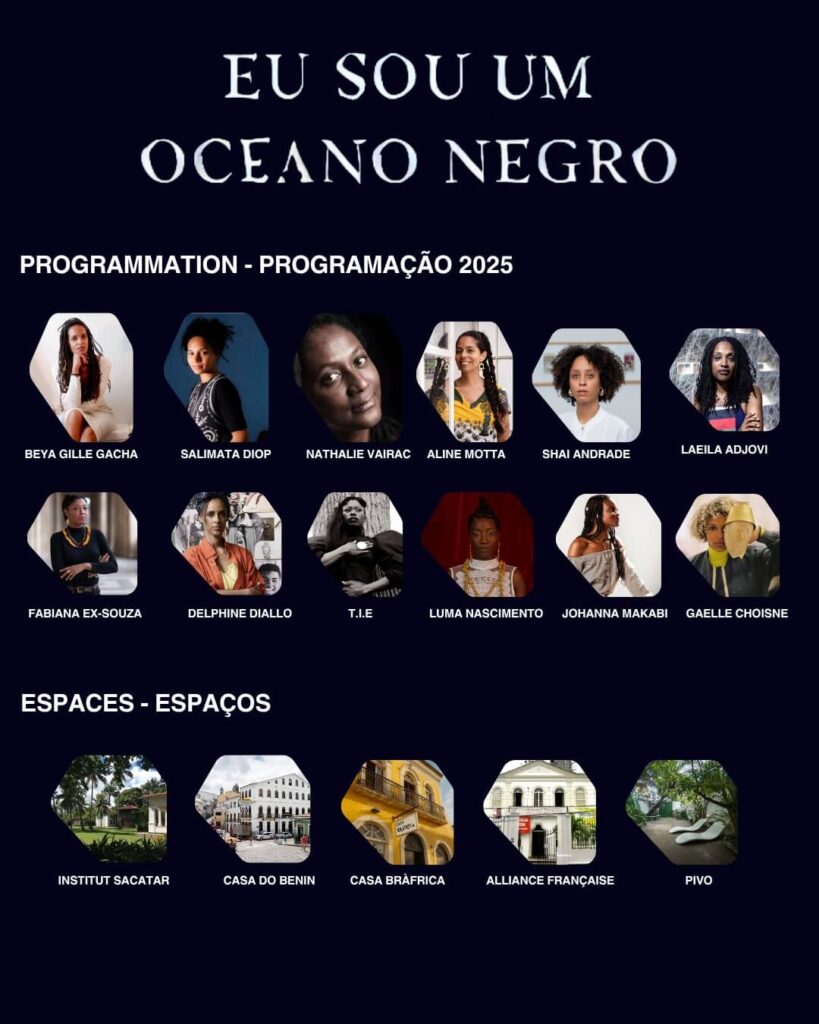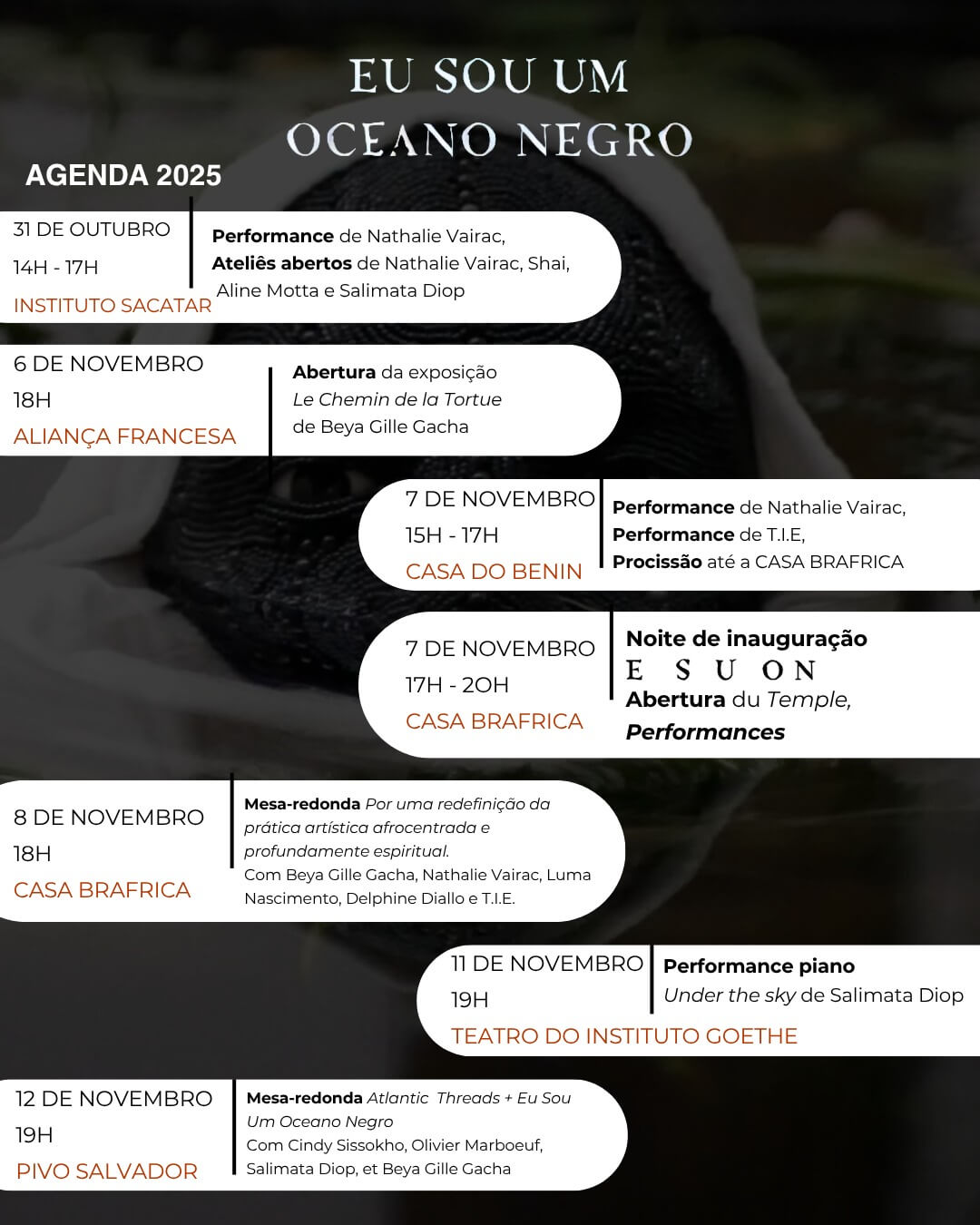

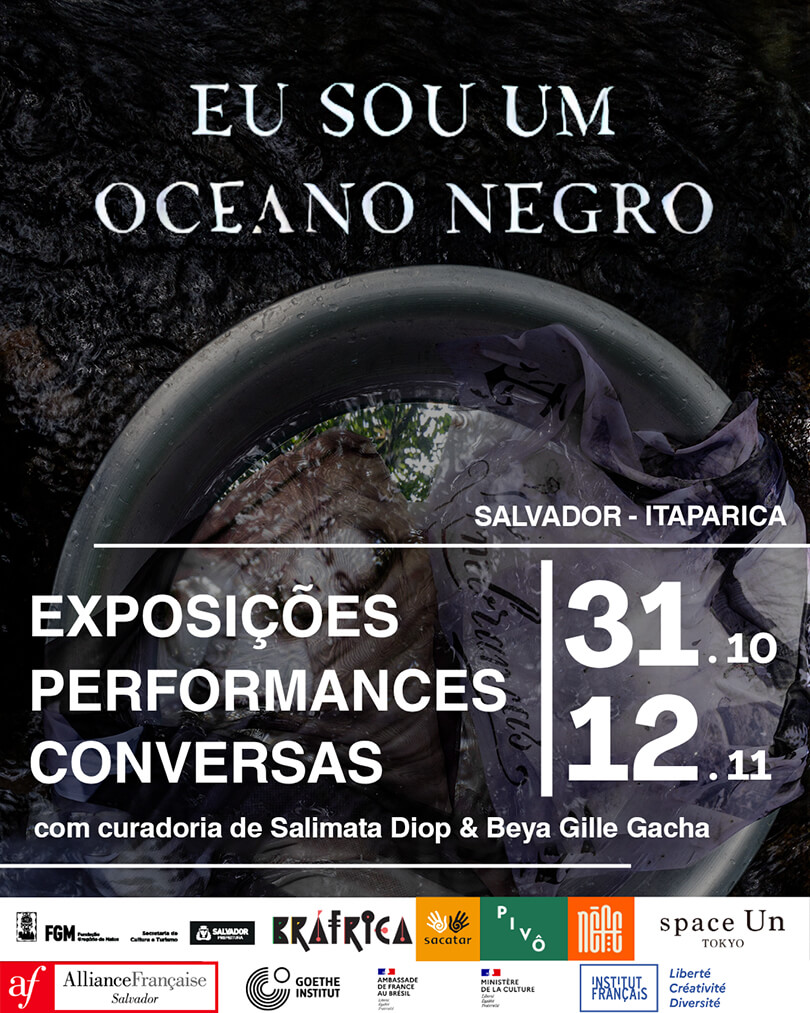
As part of Sacatar’s participation in the Year of France in Brazil, we are thrilled to play a central role in the project I Am a Black Ocean, which promotes residencies, exhibitions, performances, and roundtables in Bahia featuring artists from Senegal, France, and Brazil.
Through this project, Sacatar hosted four artists: Salimata Diop, Aline Motta, Nathalie Vairac, and Shai Andrade (Shai’s residency had the support of the Secretary of Culture of Bahia).
We are especially proud to be part of this multilateral and tricontinental collaboration, as the project originated from a former Fellow’s residency at Sacatar. The French-Cameroonian artist Beya Gille-Gacha was in residence with us last year, and the impact of that experience — along with the connections she made here — became the conceptual and institutional starting points for a project that is now coming to fruition and bringing together many other organizations.
Among the events connected to I Am a Black Ocean is the exhibition “The Way of the Turtle,” a solo presentation of Beya’s works initiated during her time at Sacatar. The exhibition will be on view at Alliance Française in Salvador, starting November 6th.
The transcontinental project of residences, exhibitions, and artistic performances Eu Sou Um Oceano Negro (ESUON) reactivates and honors the memory of the Atlantic Ocean, no longer as a “slave route” (the transatlantic slave trade, which deported around 12.5 million Africans between the 16th and 19th centuries), but as an oceanic matrix and a “common good.”
Afro-eco-feminist engagement emphasizes the interconnection between the oppression of women, the exploitation of the Earth, and imperialism. ESUON affirms that female power is essential in the face of fragmentation (identity, climate, and social crises).
Memorial Reparation: By choosing Salvador, Bahia (Brazil) for its first chapter—a city whose population is largely of African descent and whose heritage is strongly marked by the mass arrival of enslaved people—ESUON anchors its action in an important place of memory for the diaspora. Holding the event around Black Awareness Day reinforces this commitment.
Counter-narrative: The project combats the historical “erasure” and “burial” of black female pioneers. It replaces the image of passive victims with that of travelers, pioneers, and ancestral guides whose power has never been extinguished. Thus, it creates an active narrative of black female power, breaking with the exclusive focus on suffering.
The Call to Return: Countries such as Ghana (with the landmark “Year of Return” initiative in 2019, which marked the 400th anniversary of the arrival of the first African slaves in Virginia, followed by the “Beyond the Return” initiative in 2019, marking the 400th anniversary of the arrival of the first African slaves in Virginia, followed by the Beyond the Return initiative) and Benin have actively implemented policies to welcome people of African descent, facilitate their access to citizenship, and encourage cultural and economic investment.
The Spiritual Reconnection: ESUON brings this return to fruition on a spiritual and artistic level. The vision of the reform of the continents (the Cape of Brazil joining the Gulf of Guinea) is a powerful metaphor for the need to “become One” again. ESUON proposes a recomposition of what has been separated and broken, not through geopolitics, but through an unprecedented collaborative artistic creation that privileges the trail and the itinerary rather than a single root.
In conclusion, by making the Atlantic a place of healing and female encounter, ESUON is not just an artistic project, it is a living manifesto that offers the diaspora and the world a model for reconnecting history, spirituality, and the future, necessary for reparation and a more united world.
This project is supported by the following partners: Gregório de Mattos Foundation, Salvador City Hall Department of Culture and Tourism, Casa Bráfrica, Sacatar, Pivô Salvador, Nefe, Space Un Tokio, Alliance Française Salvador, Goethe Institut, French Embassy in Brazil, Ministry of Culture, and Institut Français.